

DHT vs GFC: Understanding the Purpose of No-Root Touch and GFC Hair Therapy
Hair loss is a common problem for many people today. It can affect appearance, confidence, and overall self-image. Because of this, modern aesthetic medicine has developed several advanced solutions to address thinning hair and baldness.
Among the many treatments available, two procedures often come up in hair restoration discussions: Direct Hair Transplant (DHT) using the No Root Touch Technique and Growth Factor Concentrate (GFC) therapy. Both aim to improve hair growth, but they work in very different ways.
Understanding the difference between these treatments is important before choosing a solution. While one focuses on restoring hair in bald areas, the other focuses on strengthening existing hair follicles and improving scalp health.
What is DHT (Direct Hair Transplant) with No Root Touch Technique?
The Concept of Advanced Hair Transplant
Direct Hair Transplant, often known as DHT, is an advanced hair restoration procedure. It involves transplanting healthy hair follicles from a donor area to areas where hair is missing. The technique focuses on careful graft handling and precise placement.
The No Root Touch Technique is designed to protect the hair follicle during the transplant process. Instead of handling grafts directly, surgeons use specialized implantation tools to insert them into the scalp. This helps reduce damage and supports better graft survival.
Because the follicles are implanted quickly and carefully, the method helps maintain their strength and growth ability. This makes DHT a popular option for individuals looking for natural-looking hair restoration.
Purpose of DHT in Hair Restoration
The main purpose of DHT is to restore hair in areas where follicles are already lost. When hair follicles stop functioning permanently, natural hair growth cannot return on its own. In such cases, transplantation becomes the most effective solution.
During the procedure, healthy follicles from the donor area-usually the back of the scalp–are relocated to the thinning or bald areas. These transplanted follicles continue to grow naturally in their new location.
Because donor follicles are resistant to hair loss, the results are generally long-lasting. This allows DHT to rebuild hairlines, fill bald patches, and improve overall hair density.
What is GFC (Growth Factor Concentrate) Therapy?
The Science Behind GFC Treatment
Growth Factor Concentrate therapy is a regenerative hair treatment. It uses growth factors extracted from the patient’s own blood. These growth factors help repair tissues and stimulate cell activity.
During the treatment, a small amount of blood is collected and processed to separate the growth factors. The concentrate is then injected into the scalp in areas with hair thinning.
This process sends biological signals to the hair follicles. These signals help improve follicle function and support stronger hair growth over time.
Purpose of GFC in Hair Care
The main purpose of GFC therapy is to strengthen existing hair follicles. It helps reduce hair fall and improve hair thickness. Unlike transplant procedures, it does not create new follicles.
Instead, the therapy works by improving the scalp environment. Healthy follicles receive better nourishment and support, which helps them produce stronger hair strands.
Hair Replacement vs Hair Stimulation
Understanding the Core Difference
One major difference between DHT and GFC is their purpose in hair treatment. DHT focuses on replacing hair follicles in areas where hair is already lost. GFC focuses on improving the health of existing follicles.
DHT physically relocates healthy hair follicles to bald areas. This allows new hair to grow where natural growth had stopped. As the transplanted follicles settle, they begin to grow hair just like they did in the donor area.
GFC therapy works differently. Instead of replacing follicles, it encourages existing follicles to work better. The growth factors help improve hair thickness and reduce hair shedding.
Because the treatment uses the patient’s own biological material, it is considered safe and minimally invasive. It is considered safe and minimally invasive. It is often recommended for people experiencing the early stages of hair thinning.
DHT vs GFC: Key Differences at a Glance
Understanding the differences between these treatments can help patients choose the right solution for their needs.
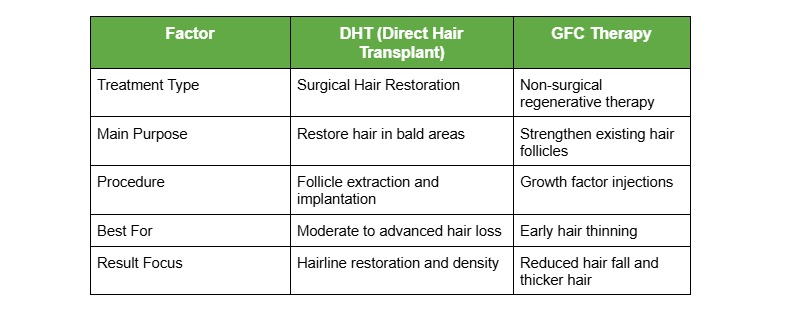
DHT focuses on rebuilding hair where follicles are missing. GFC therapy focuses on improving the quality and strength of the hair that still exists.
Both treatments address hair loss in different ways, which is why they are often used as complementary solutions rather than competing procedures.
Can DHT and GFC be Combined for Better Results?
In many cases, hair specialists recommend combining treatments for better outcomes. DHT can restore hair in areas where follicles are permanently lost, while GFC can strengthen surrounding hair.
When used together, these treatments address both structural and biological aspects of hair restoration. The transplant rebuilds the hairline and density, while the growth factors support scalp health.
GFC may also be used after a hair transplant procedure. The therapy can help improve the scalp environment and support healthy hair growth during the recovery phase.
This combined approach often leads to more balanced and natural-looking hair results.
DHT vs GFC: Which Treatment is Right for you?
Choosing the right treatment depends on the stage of hair loss. If hair follicles are already lost and bald areas are visible, hair transplantation through DHT may be the best option.
If hair thinning is still in the early stage, GFC therapy may help strengthen the follicles. The treatment can improve hair thickness and slow down hair fall before baldness progresses.
In some cases, patients benefit from both procedures. A transplant can restore lost hair, while GFC can support the health of existing follicles.
A proper scalp evaluation helps determine the most suitable treatment plan based on hair condition and restoration goals.
Conclusion
Hair restoration today offers several advanced treatment options. Among them, Direct Hair Transplant with the No Root Touch Technique and Growth Factor Concentrate therapy are two widely used procedures.
DHT focuses on restoring hair by transplanting healthy follicles into bald areas. This helps rebuild hairlines and improve overall scalp coverage with long-term results.
GFC therapy works as a regenerative treatment that strengthens existing hair follicles. It improves hair quality, reduces hair fall, and supports healthier hair growth.
Understanding the difference between these treatments helps individuals choose the most appropriate approach for their hair restoration journey.